


Every owner of a sailing yacht needs to climb the mast for periodic rigging inspection, repairs, or equipment maintenance. Often, you may find yourself needing to climb a sailboat mast alone, without the assistance of a crew.
How to climb a mast: Challenges of traditional methods
When considering how to climb a mast while sailing solo, using a winch is not an option, and professional mountaineering gear can be too complex for many sailors. While permanent mast steps are an alternative, they require drilling and permanent interference with the mast structure.

Professional Mast Ladder: A Solid Solution for Sailors
A superior alternative is the Professional Mast Ladder manufactured by 4Yachts. Made of highly durable and lightweight textile materials, our MastL, MastS, and MastXS models make climbing easier while ensuring maximum safety during any work at height.
Stability and Safety during Sailboat Mast Climbing
Attachment along the mast by slides safely stabilizes the user during climbing and working at height. This is crucial when you climb a sailboat mast on the water. Even in a safely moored marina, a slight boat swing can appear, and our sliding system keeps you steady and secure.

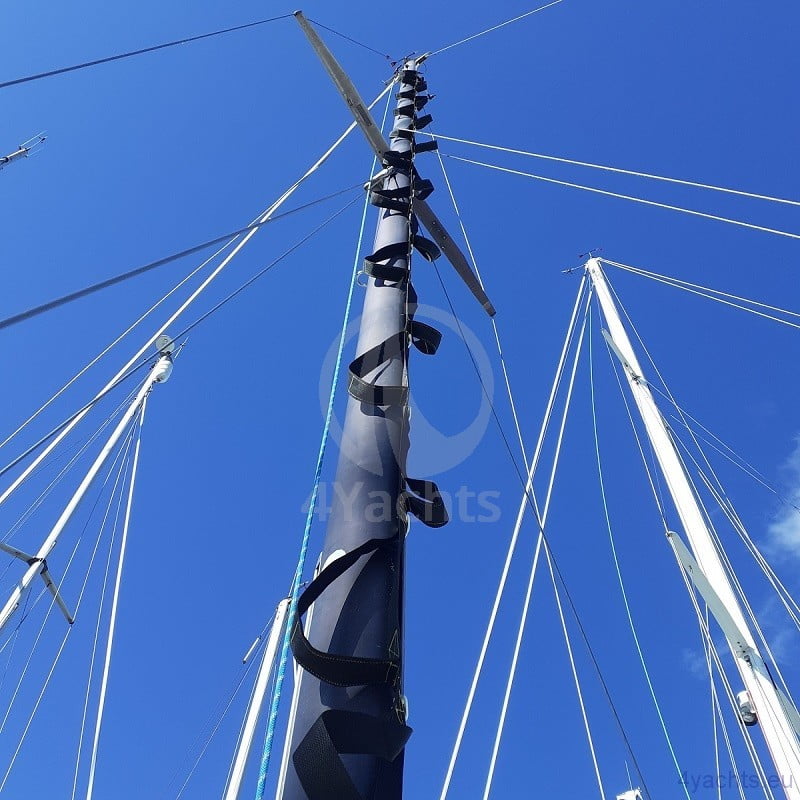
How to Hoist the Mast Ladder Using a Halyard
The mast ladder is hoisted along the mast using the mainsail halyard. The condition and quality of the halyard must guarantee the required load-bearing capacity. It is essential to verify the technical state of the entire rigging and deck hardware. Our ladder includes a dedicated hanger that ensures the required load ability.
Essential Secondary Belaying for Mast Safety
Regardless of the equipment used, always use secondary belaying. It is best to use a foresail or spinnaker halyard as a safety line. You must absolutely verify the strength of all rigging elements and knots before you start climbing the mast of a sailing yacht for any repairs.


Safety Harness
Secondary belaying must be attached to a certified Safety Harness If you use an additional halyard operated by a winch, a second person is required on board to assist while climbing the mast. For solo sailors, we recommend using dedicated self-belaying devices for maximum independence.
It is also possible to belay using a loop with a Prusik knot on an additional halyard stretched along the mast. However, it is important to remember that most halyards are static ropes. In the event of a fall, a static line does not guarantee 100% shock absorption, which is why professional fall arrest gear is highly recommended.
Fall Protection: KONG BACK-UP and DynaProt
A safer and more reliable method is to use a dedicated KONG BACK-UP locking device for additional belaying on a static halyard. The device allows you to move freely up and down while climbing the mast, providing instant blockade and shock absorption if a fall occurs. The BACK-UP device includes a certified carabiner for secure attachment.


Professional Mast Climbing Tool Bag
When working at height, a dedicated Mast Climbing Tool Bag is essential. Our bag attaches easily to your harness and features lanyards to secure tools against accidental falls. With a stiffened top edge for easy one-handed access and a secure Velcro closure, it is the perfect accessory to keep your equipment safe while climbing a sailing yacht mast.

You can buy all the above-mentioned elements in our online store. If you have any additional questions, do not hesitate to ask them via our contact form or just send by email.
Important Safety Notice:
Remember: your safety equipment must never be connected to the same mainsail halyard on which the ladder is hoisted. Always use an alternative, independent halyard or element capable of carrying the full load-bearing requirement on its own.
When using a mast ladder, it is absolutely necessary to always use additional fall protection. Use only professional equipment that meets all safety requirements and carries valid certificates.